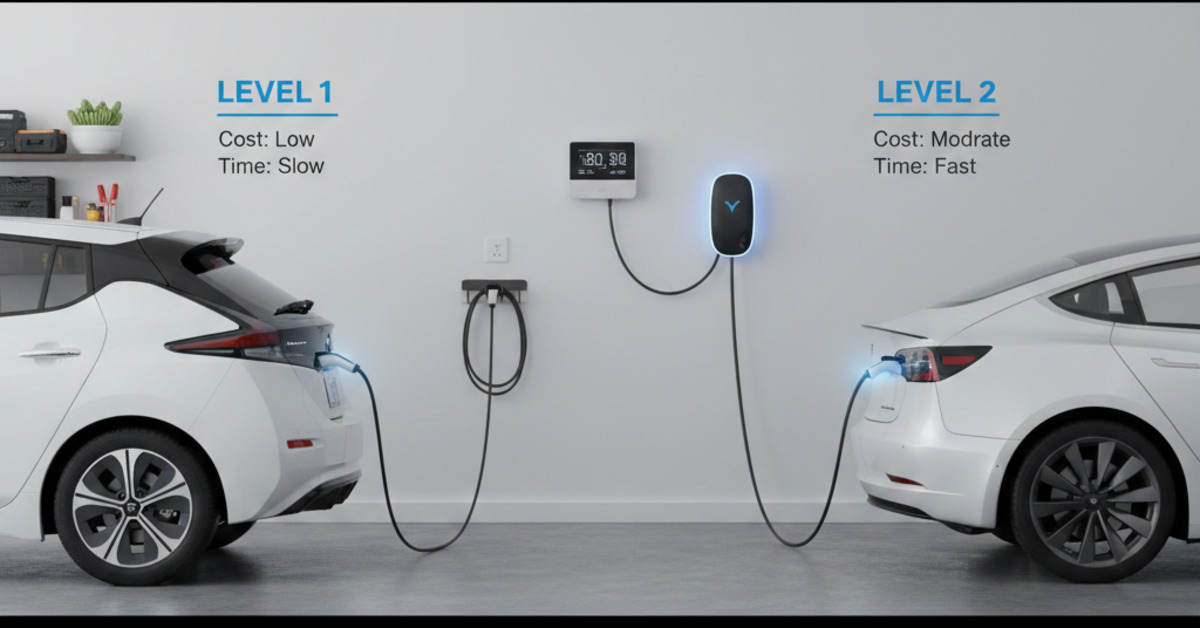
Electric Vehicle Charging at Home: Level 1 vs. Level 2 Costs
So you've made the switch to an electric vehicle (EV). Congratulations! You're helping the environment and saving money on gas. But now you're probably wondering about the best and most cost-effective way to charge your new car at home. The two main options for home charging are Level 1 and Level 2. In this guide, we'll break down the costs and benefits of each to help you make an informed decision.
Level 1 Charging: The Simple Solution
Level 1 charging is the simplest and most affordable way to charge your EV at home. It uses a standard 120-volt wall outlet, the same kind you use to plug in your toaster or your TV. Every new EV comes with a Level 1 charging cord, so you don't need to buy any extra equipment.
Pros:
- No extra cost: You can use the charging cord that came with your car and any standard wall outlet.
- Easy to use: Just plug it in and you're good to go.
Cons:
- Slow charging speed: Level 1 charging is very slow. It typically provides about 3-5 miles of range per hour of charging. This means it can take several days to fully charge an EV with a large battery.
- Not ideal for daily use: If you drive your EV every day, a Level 1 charger may not be able to keep up with your charging needs.
Cost: The only cost associated with Level 1 charging is the cost of electricity. This will vary depending on where you live, but it's typically much cheaper than gasoline.
Level 2 Charging: The Faster, More Convenient Option
A Level 2 charger uses a 240-volt outlet, the same kind that is used for a clothes dryer or an electric oven. This allows for much faster charging speeds than a Level 1 charger. A Level 2 charger can typically provide about 25-30 miles of range per hour of charging. This means you can fully charge your EV overnight.
Pros:
- Faster charging speed: A Level 2 charger can fully charge your EV overnight.
- More convenient: With a Level 2 charger, you can wake up to a fully charged car every morning.
Cons:
- Higher upfront cost: A Level 2 charger needs to be professionally installed, and the cost of the charger and installation can range from $500 to $2,000.
- Requires a 240-volt outlet: If you don't already have a 240-volt outlet in your garage, you'll need to have one installed by an electrician.
Cost: The cost of a Level 2 charger and installation can vary depending on a number of factors, including the type of charger you choose and the complexity of the installation. However, there are often government incentives and rebates available to help offset the cost.
Which One is Right for You?
The right choice for you will depend on your driving habits and your budget.
- Choose a Level 1 charger if: You have a short commute and you don't drive your EV every day.
- Choose a Level 2 charger if: You have a long commute and you drive your EV every day. A Level 2 charger is also a good choice if you want the convenience of being able to fully charge your car overnight.
While a Level 2 charger has a higher upfront cost, it's a worthwhile investment for most EV owners. The convenience and peace of mind of knowing that you'll always have a fully charged car is well worth the cost.