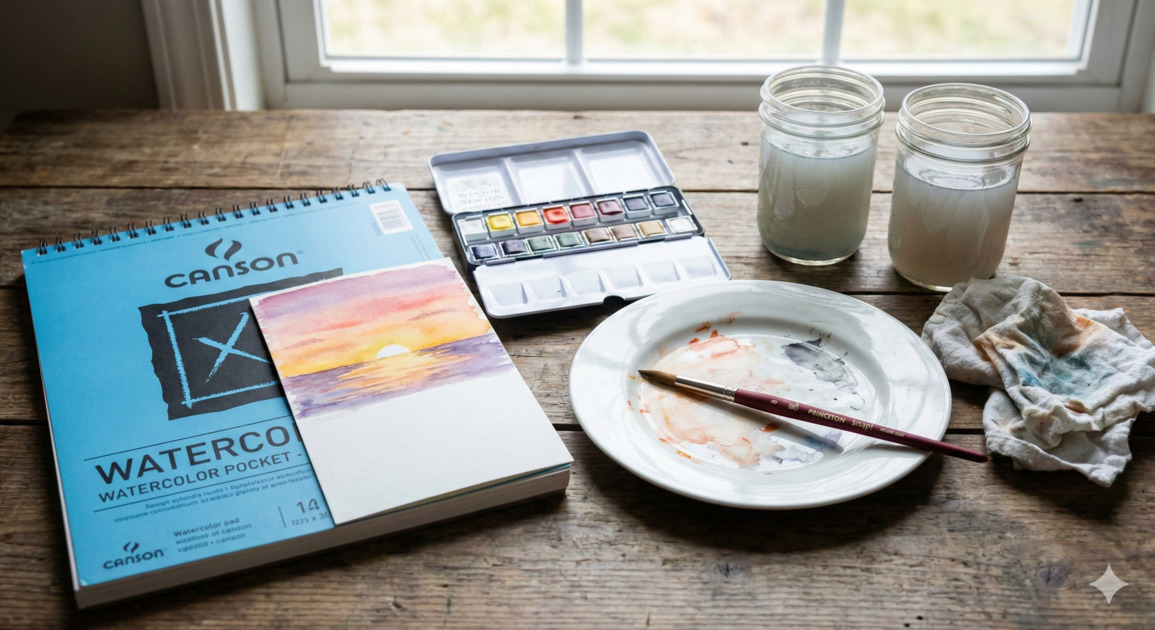
How to Start Watercolor Painting: Supplies Under $50
There is a common myth that keeps many aspiring artists from ever picking up a brush: the idea that you need expensive tools to make good art. It is easy to get intimidated by art store aisles filled with $80 sable brushes and $20 tubes of pigment.
But the truth is, watercolor is one of the most accessible mediums in the world. It requires minimal space, easy cleanup, and surprisingly little gear. If you have been wanting to dip your toes into painting without emptying your wallet, you are in the right place.
Here is exactly how to start watercolor painting with a high-quality kit for under $50.
1. The Paper: Splurge Here (Approx. $10 - $15)
If you only take one piece of advice from this guide, let it be this: Paper is more important than paint.
You can make cheap paint look good on expensive paper, but expensive paint will look terrible on printer paper. Standard paper will warp, buckle, and pill when wet.
- What to buy: Look for "Cold Press" paper, which has a slight texture that holds water well.
- The Budget Pick: The Canson XL Watercolor Pad (140lb/300gsm) is widely considered the best cheap watercolor paper for beginners. It stands up to heavy washes and costs a fraction of professional cotton paper.
2. The Paint: Pans Over Tubes (Approx. $15 - $20)
Watercolors come in two forms: liquid tubes and dry "pans." For beginners, pan sets are superior. They are portable, less messy, and easier to control.
You don't need 50 colors. You need a set with good transparency and pigment load.
- What to buy: Stick to "Student Grade" paints. They have slightly less pigment than professional sets but behave very similarly.
- The Budget Pick: The Winsor & Newton Cotman Sketchers Pocket Box is legendary. It usually costs under $20, fits in a pocket, and contains 12 high-quality colors that mix beautifully. Alternatively, Prang Watercolor sets (yes, the oval ones) are shockingly good for the price if you are on an extreme budget.
3. The Brushes: You Only Need Two (Approx. $10 - $12)
Do not buy the "Value Pack" of 20 cheap brushes. Most of them are useless sizes that shed hairs onto your painting.
You really only need one or two good synthetic watercolor brushes. Synthetic bristles are durable, snap back into shape, and are affordable.
- What to buy:
- Round Size 8 (or 10): This is your workhorse. It is large enough to wash a sky but has a fine point for details.
- Round Size 4: (Optional) For finer details.
- The Budget Pick: Brands like Princeton Snap! or Royal & Langnickel Zen offer fantastic synthetic brushes for about $5-$7 each.
4. The Free Stuff (Household Items)
The rest of your kit can be found in your kitchen.
- Palette: You don't need to buy a plastic palette. A white ceramic dinner plate works perfectly. The porcelain surface is easy to clean and allows you to see the true color of the paint.
- Water Containers: Use two old jars or yogurt cups. One for rinsing dirty paint off your brush, and one for clean water to wet your paints.
- Rag: An old cotton t-shirt or paper towels for blotting your brush.
The Final Tally
- Paper: Canson XL Pad (~$12)
- Paint: Cotman Pocket Set (~$18)
- Brush: Princeton Snap Size 8 (~$7)
- Total: $37
Final Thoughts
You now have a fully functional watercolor studio for less than the price of a video game. Don't wait for the "perfect" expensive gear. The magic isn't in the supplies; it's in the practice. Grab your $37 kit and start painting today.