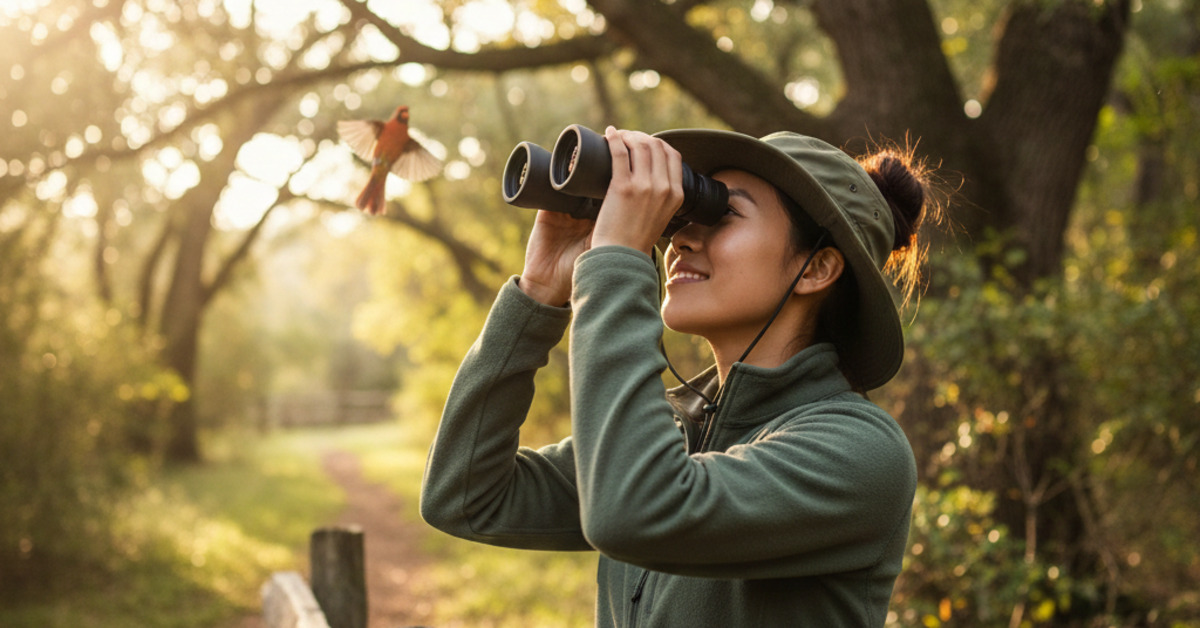
Your Window to the World of Birds
So, you've decided to start birdwatching. It's a wonderful hobby that connects you with nature, sharpens your observation skills, and can be done anywhere, from a remote forest trail to your own backyard. While you can start with just your eyes and ears, you'll quickly discover that to truly appreciate the beauty and detail of birds, you need a good pair of binoculars.
But a quick search for binoculars reveals a confusing mess of numbers, features, and price points. This introduction to birdwatching guide will demystify the process and help you understand how to choose binoculars that are perfect for a beginner.
Understanding the Numbers: What Does "8x42" Mean?
Every pair of binoculars is described by two numbers, like 8x42 or 10x50. These are the two most important specifications you need to understand.
- The First Number (Magnification): In "8x42," the "8x" stands for magnification. This means the object you are looking at will appear 8 times closer than it does with your naked eye. While it might be tempting to go for the highest magnification possible, this is a common beginner mistake. Higher magnification (like 10x or 12x) makes the image shakier and harder to hold steady, and it also narrows your field of view, making it harder to find the bird in the first place.
- The Second Number (Objective Lens Diameter): In "8x42," the "42" stands for the diameter of the large front lenses, measured in millimeters. This number determines the binocular's light-gathering ability. A larger number means more light, resulting in a brighter, clearer image, which is especially important in low-light conditions like dawn, dusk, or under a forest canopy.
The Sweet Spot: Why 8x42 is the Gold Standard for Birding
For most birders, 8x42 binoculars are the perfect all-around choice, and they are almost always the top recommendation for beginners.
- 8x Magnification: This provides plenty of power to see details on small birds, but it's also stable enough to hold steady without a tripod. It offers a wider field of view (the width of the image you can see), which makes it much easier to initially spot a bird and then follow it as it moves.
- 42mm Objective Lens: This provides excellent brightness and clarity in a wide range of lighting conditions, without making the binoculars too big or heavy.
Other Key Features to Look For
- Field of View (FOV): Measured in feet per 1,000 yards or in degrees, this tells you how wide of an area you can see. A wider FOV is better for scanning and finding birds.
- Eye Relief: This is the distance between the eyepiece and your eye where you can see the full image. If you wear glasses, this is a critical feature. Look for an eye relief of 16mm or more to ensure you can see the entire field of view with your glasses on.
- Waterproofing and Fog-Proofing: Birds are often most active in the early morning when there's dew on the ground. A good pair of birding binoculars will be O-ring sealed (waterproof) and nitrogen-purged (fog-proof) to handle changes in temperature and weather.
How Much Should You Spend?
While you can buy binoculars for $30, you'll likely be disappointed with the image quality. The good news is that you don't have to spend a fortune. The quality of entry-level binoculars has improved dramatically in recent years.
- The Beginner's Budget: Plan to spend between $100 and $250 for your first pair. Brands like Nikon (the Monarch series), Vortex (the Diamondback series), and Celestron (the Nature DX series) all offer fantastic, highly-rated 8x42 models in this price range.
Your first pair of good binoculars will completely transform your birdwatching for beginners experience. They are the single most important piece of beginner birding gear you can invest in, and they will open up a world of detail, color, and behavior that is invisible to the naked eye.