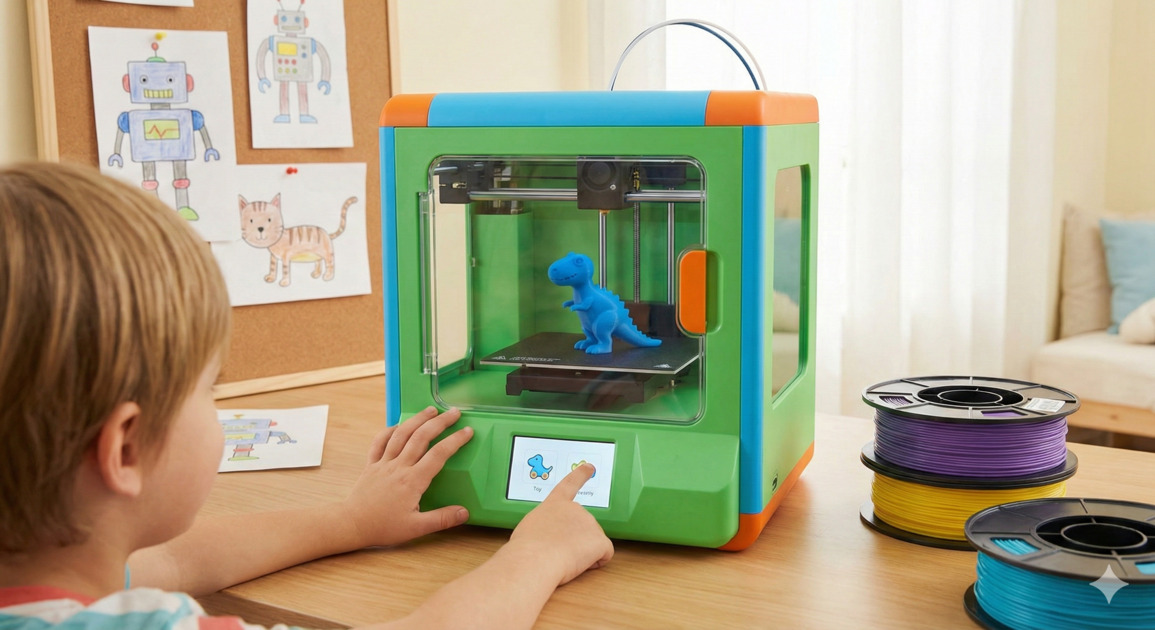
Best Beginner 3D Printer for Kids (Safe & Easy to Use)
Watching a child’s drawing or digital design transform into a physical, tangible object right before their eyes is magical. It turns passive screen time into active creation. However, the world of 3D printing can feel overwhelming, filled with technical jargon and machines that get incredibly hot. Finding the best beginner 3D printer for kids means prioritizing two things above all else: safety and frustration-free operation.
This guide will walk you through what features define a truly kid-friendly machine, ensuring your little engineer's first experience is full of fun, not troubleshooting.
Safety First: The Non-Negotiables
When choosing a starter 3D printer for children, safety is paramount. Standard 3D printers have nozzles that reach dangerously high temperatures (over 200°C or 392°F) and moving parts that can pinch fingers.
For peace of mind, look for an enclosed 3D printer for safety. These models have doors and side panels that act as a barrier, keeping curious hands away from the hot end and print bed during operation.
Another crucial factor is the material used for printing. You want a machine optimized for PLA (Polylactic Acid) filament. PLA is a biodegradable plastic derived from renewable resources like cornstarch. It prints at lower temperatures and doesn't emit noxious fumes, making it considered a kid-safe 3D printing filament perfect for home environments.
Keeping it Simple: "Plug and Play" Features
A complex setup is the fastest way to kill enthusiasm. The ideal introductory 3D printer models are nearly ready to go right out of the box. Avoid kits that require hours of assembly.
Look for these key "easy-to-use" features:
- Auto-Bed Leveling: Traditional printers require manual calibration of the print bed, which is notoriously difficult for beginners. An auto-leveling feature handles this automatically, ensuring the first layer sticks perfectly every time.
- Simple Interface: A touchscreen with intuitive icons is far better than a complex knob-and-menu system. The best printers for kids often have companion apps filled with pre-tested models, allowing for "one-click printing" without needing complex slicing software initially.
- Removable Print Bed: A flexible, magnetic print bed makes popping the finished model off a breeze, removing the need for sharp scrapers.
Choosing Your Style
Generally, plug and play 3D printers for kids fall into two categories.
First are the "toy-box" style printers. These are often compact, fully enclosed, and rely heavily on an app with a pre-curated library of toys. They are fantastic for younger kids who just want to hit "print" and play.
Second are mini versions of standard printers. These look like scaled-down professional machines but come with safety enclosures and simplified features. These are better as an educational 3D printer for home, as they offer room to grow into learning actual 3D modeling software later on.
By focusing on a fully enclosed design, PLA compatibility, and automatic features, you can find a safe and engaging tool that will spark hours of creative learning.